
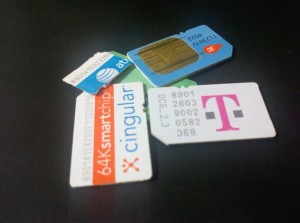
 In a drawer, I found several old SIM cards from American phone companies. There was a T-Mobile SIM card, which holds fond memories from my time in Manhattan, NY, and another from Cingular, which, like T-Mobile, no longer exists. The AT&T one in the upper left is the remnant after I punched it out for some reason.
By the way, I think most people are already familiar with SIM cards, the small cards that are inserted into these mobile phones. They contain the subscriber's phone number information and other data. Back in the days of so-called "Galapagos phones," there was no such thing as a SIM card; you had to go to a mobile phone shop and have the data written directly into the phone's ROM. I think those kinds of mobile phones no longer exist.
SIM cards are standardized in shape and size, making them universal worldwide. However, in Japan, a country heavily influenced by vested interests, mobile phones are locked to specific carriers—Docomo phones use Docomo SIM cards, Softbank (then Vodafone) phones use Softbank SIM cards, and so on. Naturally, there's no compatibility between phones and carriers. (Although things seem to be changing somewhat recently.)
I have some memories associated with this SIM card...
As I mentioned before, I had unlocked the locks on my old smartphones, the M1000 and Hermes, using a certain method. As long as the communication specifications matched, I could use SIM cards from Docomo, Softbank, or any other company in the world. With just a SIM card, I could make local calls freely and without any worries. I'm strangely drawn to this kind of convenience, comfort, and global accessibility.
However, buying just a SIM card in the US back then was quite difficult. Initially, SIM cards were typically purchased together with a mobile phone, or you were replacing an old phone with a new one; it wasn't common to buy a SIM card on its own.
In my case, the Hermes phone was made by the American company Cingular, so that was fine, but I had quite a bit of trouble with my previous phone, the Docomo M1000. When I arrived in Manhattan from JFK Airport, the first thing I looked for was a mobile phone shop. I chose one that seemed easy to enter with few customers, and nervously showed the shopkeeper my M1000 and asked for "just a SIM card." They looked at me like, "What kind of phone is this?!" It wasn't that smartphones were unusual, but rather that the phone itself was unusual. It was a Motorola, a familiar brand to them, but it was a shape they'd never seen before (it was a phone produced by Motorola for overseas markets, so it wasn't sold in America), and an Asian person brought in something with incomprehensible "FOMA" or "NTT DoCoMo" written on it and asked for "just a SIM"... Of course, they were suspicious. They refused, saying "We're not allowed."
But undeterred, I went to the T-Mobile shop next door and, changing my approach this time, asked the salesman, "Have you ever seen a phone like this before?" As expected, he was intrigued and readily sold it to me. He brought out a stack of about 50 SIM cards from the back yard, let me choose a good Manhattan area phone number, and even did a proper communication test for me! ...If pushing doesn't work, try pulling. Expression is important. During my stay, I rented a car and traveled by car the whole time, so not having a phone would have been a matter of life and death for me, so I was incredibly grateful.
And so, I successfully achieved a "convenient, comfortable, anytime, anywhere, global digital life."