
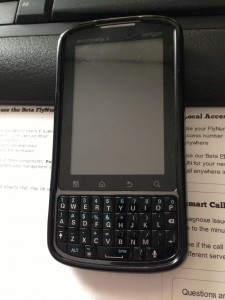
 I've always preferred devices with a candy bar-type physical keyboard, and that's how I ended up with the Motorola Droid Pro. This device, running Android OS and boasting fairly high specifications, still seems to have a strong following. It features a Texas Instruments OMAP3620 (1GHz) processor, 1.5GB of RAM, a 3.1-inch display, and a straight body with a QWERTY keyboard. It's what you might call a Blackberry-style Android phone. It's very user-friendly, easy to type on, and ideal for business use. Despite the smartphone boom in Japan, no carrier has adopted this type of phone. On top of that, Blackberry is apparently withdrawing from Japan. ...What a shame.
Lately, my Droid Pro, which I'd been using for a long time, had been acting up. Packet transitions were unstable, I was experiencing increased echo when using VoIP, it would suddenly reboot, and even though I had set the Wi-Fi sleep policy to Never Sleep, it would turn off after a while... And recently, I could access the internet, but I couldn't make phone calls (and of course, I couldn't receive any calls either). I figured this was getting out of hand, so I decided to get a new one.
I started using smartphones back in the days of the original Symbian OS, and then I was blown away by the convenience of Windows Mobile, which was groundbreaking at the time, and I used it extensively. Around that time, Apple announced the iPhone. However, it wasn't 3G compatible, so it couldn't be used in Japan. Then, suddenly, rumors started circulating that ”Google is releasing ”gPhone'!" And then Google announced the open-source Android OS. I liked Google's concept of OSS (open source software), so I jumped at the chance. I used Android for a while, and during that time, the smartphone boom hit Japan. Even now, there are still many people who think of iPhones when they think of smartphones, which shows just how well-established the iPhone market has become in Japan.
The iPhone doesn't have a physical keyboard, nor is it open source, and Apple's market thinking as a huge, self-established company felt somewhat like Japanese business practices, which honestly made me feel a bit wary of it. On the other hand, I was impressed by their brand building and propagation methods, and I was also drawn to its simple yet functional design. I also wanted to try iOS (and learn about its inner workings), and I wanted to actually test the IP-PBX I'm currently researching in this mobile environment.
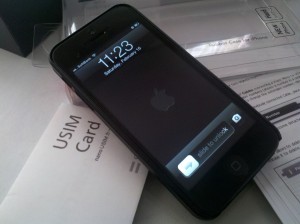 To be honest, I was quite hesitant, but I finally decided to buy an iPhone 5 with iOS 6. The deciding factors were that it has LTE and legally supports tethering.
I've been using it for five days now, and it's far better than I expected! The truly intuitive user experience is something Android just doesn't have. It's a bit late to say this, but I really felt the power of Apple.
My main concern was the flexibility of Gmail and Google Apps. While there are certainly drawbacks stemming from the ongoing conflict with Google, there seem to be technical ways to circumvent them, and aside from the rather poor navigation app, everything else is practically fine. Text input via the touchscreen is linear and easy to use on the iPhone, and I quickly got used to it. And then there's Siri, which is incredibly convenient. You can really enjoy having conversations with it. When it was first announced, one American critic made the nonsensical comment that "Siri will probably not be accepted in Japan because it means 'buttocks' in Japanese," but after using it, I realized just how excellent iOS 6's Voice Recognition feature is.
I've also been experimenting with using Acrobits Softphone for my IP-PBX, and it's quite good! I'm using it as one of the extensions for my IP-PBX, and thanks to LTE, it's very usable. When a call comes in to the company's main number, not only the office phone but also my iPhone gets ringed, and whoever answers first gets to talk. I can also make external calls from my iPhone while I'm out, so I can keep my phone bills extremely low (or even free).
What's even more amazing about Acrobits Softphone is that it can also be used to set up Google Voice. Since I have an Illinois phone number through Google Voice, if someone calls that number from the US, my iPhone will ring. Google Voice offers ”call US and Canada for free,” so now I can make unlimited free calls to the US and Canada 24/7, 365 days a year!
And so, I finally became an iPhone beginner. I knew I shouldn't be so picky, but it seems I ended up liking the sweet nectar more than I expected.
Apple pleasantly surprised me and exceeded my expectations.