
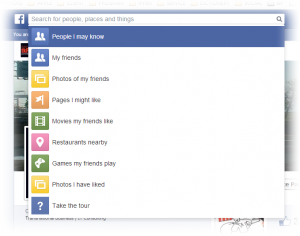

Last weekend, Facebook's specifications changed in the United States. ...Or rather, it underwent a complete transition. It was fully released last weekend, featuring the groundbreaking search system “Graph Search.”
Currently, it's only available in English, but it will eventually be introduced in Japanese as well. That said, it's likely that this will come as a complete surprise to general users. And they might not even notice it when it's implemented. However, this system is undoubtedly worth paying attention to as a new search system different from Google. It also goes without saying that it's extremely important for users to understand how what they post is being disseminated to others on the internet.
So, what exactly is Graph Search? How is it different from traditional searches like Google? You might be wondering. Facebook explains that "Graph Search is completely different from traditional web searches." It's not about searching for links using "words" or "phrases." In short, it's a "means of finding things that have been shared on the Open Graph, such as people, objects, photos, hobbies, and information."
Open Graph is a system that allows users to share photos they comment on, website information, music they listen to, and more, with the entire world. Social media platforms like Facebook operate using a standard called OGP (Open Graph Protocol).
(When managing a website, especially when linking Facebook to a company, store, or personal website or blog, there's a huge difference between implementing Open Graph Protocol (OGP) and not. Its importance is clearly undeniable. Unfortunately, however, this is surprisingly little known. Perhaps we must say we're still in the early stages of its development…)
For example, by entering "people who love cockatiels" into Graph Search, you can get search results that match exactly that. You can also search for "friends who like dancing," "bands my friends listen to," or "friends from work who ski," etc. You can search for "tourist destinations my friends have visited," look at photos and information taken there, and decide where to go next. A variety of search approaches are possible.
This Graph Search feature has actually been available as a beta version to users of the English version of Facebook since the beginning of 2013, so I think there are already some people in Japan who are using it secretly (?).
Graph Search will undoubtedly enable new information indexing and search styles. In terms of advertising and information dissemination, content that has not previously considered OGP will likely need to be re-evaluated. Furthermore, beyond its convenience, its secondary effects should also be considered. For example, as evidenced by the possibility of searches that resemble dating apps or even stalker-like searches such as "a friend of a friend, single, lives in the same town, is female, and likes cats," security issues will undoubtedly be highlighted.
In many ways, the importance of IT literacy is likely to accelerate even further.
With the advancement of graph search, the world of websites will likely evolve into an even more complex and multifaceted landscape.
By the way, regarding the new Facebook search optimization settings,HereSee below.